
For over two decades, the International Space Station (ISS) has been humanity’s home in orbit — a place where astronauts from around the world have lived, worked, and pushed the boundaries of science. But in 2030, this era will come to an end. NASA, along with its international partners, has confirmed an ISS deorbit plan that will send the station into a controlled descent, ending its life in the remote waters of Point Nemo — Earth’s so-called spacecraft cemetery.
In this in-depth guide, we’ll explore when the ISS will crash, why it’s being decommissioned, how the deorbit will happen, where it will land, and what comes next for the future of space exploration. We’ll also dive into the ISS legacy, ISS crash timeline, ISS deorbit vehicle, ISS debris risk, and the next generation of space stations.
1. The Legacy of the ISS: Two Decades of Human Spaceflight
Launched in 1998 and continuously inhabited since November 2000, the ISS is the largest human-made structure ever placed in orbit. It stretches over 357 feet — roughly the size of a football field — and has hosted more than 260 astronauts from 20 nations.
Over its lifetime, the ISS has been the site of iconic experiments in microgravity, from studying protein crystal growth to testing water purification systems now used in disaster zones on Earth. It has been a symbol of international cooperation, with NASA, Roscosmos, ESA, JAXA, and CSA working side by side.
The emotional impact of its retirement is profound. For many, the ISS represents the end of an era in space — a reminder of what humanity can achieve when nations unite for a common goal. The ISS has also served as a platform for STEM education, inspiring students worldwide to pursue careers in science and engineering.
Its contributions to space medicine, robotics, and Earth observation have laid the groundwork for future missions to the Moon and Mars. The ISS has also helped refine technologies for long-duration spaceflight, essential for deep space exploration.
2. Why Is the ISS Crashing? Understanding the End-of-Life Decision
The ISS is not crashing because of failure, but because of inevitable aging. After more than 30 years in orbit, its structure has endured constant exposure to micrometeoroids, radiation, and thermal stress. Maintenance costs are rising, and safety risks increase each year.
NASA and its partners have determined that the ISS end of life will occur around 2030. The decision balances funding priorities, international politics, and the need to make way for commercial space stations that will take over low Earth orbit operations.
So, why are they crashing the ISS? Because keeping it in orbit indefinitely is neither safe nor cost-effective. Controlled deorbit ensures it won’t become dangerous space junk or pose an uncontrolled deorbit risk.
Additionally, the ISS has reached a point where technological obsolescence makes upgrades impractical. The shift toward private space infrastructure reflects a broader trend in the space economy, where innovation and sustainability are key.
3. When Will the ISS Crash? The 2030 Timeline
The official ISS crash date is targeted for January 2031, though the deorbit process will begin in late 2030. The timeline for the ISS deorbit includes months of preparation, module shutdowns, and crew evacuation.
As of now, the ISS is still fully operational, hosting astronauts conducting research. The decision to deorbit was made jointly by NASA and international partners after extensive analysis of structural health and mission priorities.
Leading up to the ISS final descent, mission planners will coordinate with ground control teams to ensure a smooth transition. The ISS deorbit schedule will be updated regularly to reflect technical and geopolitical developments.
Public outreach campaigns will also educate the global audience about the ISS retirement, ensuring transparency and engagement.
4. How Will the ISS Be Deorbited? The NASA & SpaceX Plan
The NASA ISS deorbit plan involves a specially designed U.S. Deorbit Vehicle, contracted to SpaceX. This spacecraft will dock with the ISS and gradually lower its orbit in a controlled reentry sequence.
- ISS breakup altitude: Around 80 km above Earth, the station will begin to disintegrate due to atmospheric friction.
- ISS deorbit trajectory: Carefully calculated to ensure debris falls in a safe zone.
- How long will the ISS deorbit take? The final descent will last just a few hours, but planning and positioning will take months.
This method ensures the ISS atmospheric reentry is predictable, avoiding any chance it could crash on land. The ISS deorbit vehicle specs include advanced navigation and propulsion systems to manage the descent.
SpaceX’s involvement highlights the growing role of private aerospace companies in managing critical space infrastructure. The ISS deorbit mission will be one of the most complex operations ever attempted in low Earth orbit.
5. Where Will the ISS Crash? Point Nemo, Earth’s Spacecraft Cemetery
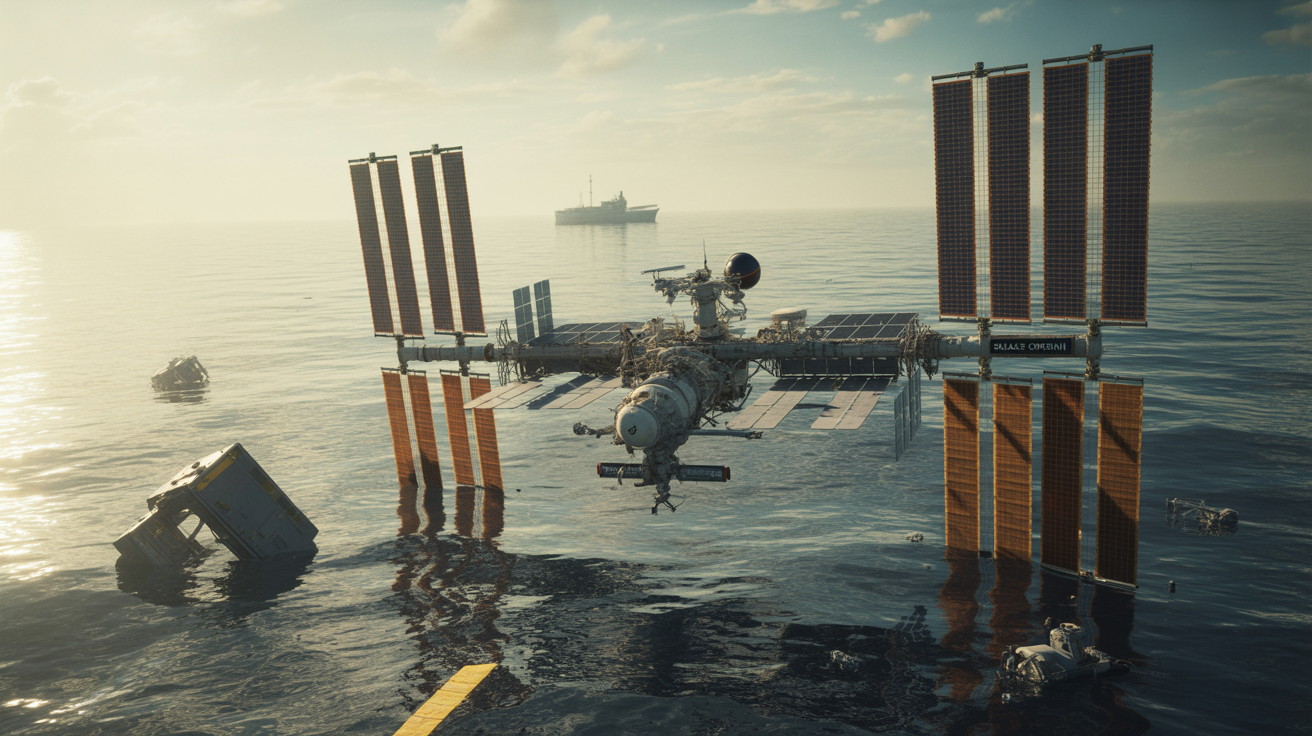
The ISS crash location map points to Point Nemo — the Oceanic Pole of Inaccessibility in the South Pacific Ocean Uninhabited Area. This spot is over 2,600 km from any land, making it the safest place for large spacecraft reentry.
Point Nemo has been the final resting place for over 300 spacecraft, including the Mir space station crash in 2001. At the bottom of Point Nemo lies a graveyard of satellites and station fragments — a true spacecraft cemetery.
The ISS reentry zone is chosen to minimize risk to human life and property. The ISS crash site coordinates will be monitored closely during the descent.
Environmental monitoring teams will assess the impact of ISS debris on marine ecosystems, ensuring compliance with international safety standards.
6. Will Any Debris Survive? The Risk Factor
During space station reentry, most of the ISS will burn up due to extreme heat. However, some surviving ISS debris — such as dense metal components — may reach the ocean floor.
NASA has studied the environmental impact of Point Nemo and determined it to be minimal, as the area is devoid of human activity. Still, concerns remain about toxic materials in the ISS and the long-term effects on marine ecosystems.
Experts will track ISS debris trajectory and analyze ISS reentry simulations to predict outcomes. The ISS crash risk is considered low, but contingency plans are in place.
International agencies will collaborate on ISS debris recovery and marine impact studies to ensure transparency and accountability.
7. What Happens to Astronauts and Operations Before Deorbit?
Before the ISS decommissioning, all crew will return to Earth. Scientific experiments will be concluded or transferred to other platforms. Valuable hardware will be removed where possible.
The decommissioning process will involve shutting down modules in stages, ensuring safety and preserving data. By the time the ISS final orbit is reached, the station will be uncrewed and prepared for its final descent.
NASA will coordinate with commercial partners to relocate ongoing research to private space stations. The ISS crew evacuation plan includes multiple return vehicles and emergency protocols.
Educational outreach will celebrate the ISS legacy, highlighting its role in advancing human spaceflight and international collaboration.
8. What Will Replace the ISS? The Future of Space Stations
The future of the ISS is tied to the rise of commercial space stations. Projects like Axiom Station, Orbital Reef, and Starlab are already in development, aiming to continue research and tourism in low Earth orbit.
This post-ISS era will see private space stations take the lead, supported by NASA and other agencies. The future of space exploration will also focus on lunar missions and Mars preparation.
These new platforms will offer space tourism, microgravity research, and commercial manufacturing. The low Earth orbit economy is expected to grow rapidly, driven by innovation and investment.
NASA’s Artemis program and international lunar initiatives will complement the shift, marking a new chapter in human spaceflight.
9. Political and Financial Stakes of Deorbiting the ISS
The cost to deorbit the ISS is estimated in the hundreds of millions, but it’s a fraction of the $100 billion spent building and operating it. The economic impact of retiring the ISS includes shifting budgets toward new missions.
Politically, the ISS has been a symbol of international cooperation in space. With Russia leaving the ISS after 2028 and tensions between nations, the future of international space collaboration is uncertain.
Space policy experts are evaluating the geopolitical implications of ISS retirement, including the rise of national space programs and space diplomacy.
The transition to commercial space operations will reshape alliances and funding models, influencing the global space economy.
Conclusion: The End of an Era, the Start of a New One
The legacy of the International Space Station is unmatched. It has taught us how to live in space, inspired generations, and proven that cooperation can transcend borders.
Its controlled deorbit into Point Nemo will mark the safe conclusion of a remarkable chapter in human history. While the ISS will be gone, its spirit will live on in the next big space projects — paving the way for humanity’s future among the stars.
As we look ahead, the ISS crash in 2030 will be remembered not as an end, but as a transformation. The future of space stations is bright, and the journey continues.

